
Choosing a proprietary trading firm involves more than comparing account sizes and profit targets. The way a challenge is billed can significantly affect its total cost, especially if you need several weeks to complete an evaluation or fail your first attempt.
Some firms charge a one-time fee for a challenge. Others use recurring subscriptions, which may continue until you pass, cancel, or lose the account. There are also hybrid arrangements: a low monthly payment followed by an activation fee, or a one-time challenge fee that is refunded only after certain payout conditions are met.
Neither pricing model is automatically cheaper. A one-time fee can be expensive if every failed attempt requires another purchase, while a subscription can become costly if the evaluation takes several billing cycles. The sensible choice depends on your trading pace, experience, available budget, and the exact terms of the program.
How the Two Pricing Models Work
A one-time payment gives you access to a specific evaluation for a single upfront charge. If you fail, you will generally need to purchase another challenge or pay for an eligible reset. Some firms refund the original fee after a qualifying payout, but that refund is conditional rather than guaranteed.
A subscription charges you repeatedly, commonly every month. This arrangement may offer a lower initial payment, but the cost accumulates while the subscription remains active. Depending on the provider, passing the evaluation may also trigger a separate activation fee or other charges.
Before comparing firms, distinguish between three amounts:
- Entry cost: What you pay to start the challenge.
- Total evaluation cost: All subscription payments, resets, activation fees, and other mandatory charges incurred before reaching the next stage.
- Net cost after a qualifying refund: The amount remaining after a refund has actually been earned and paid.
The third figure should not be used as your initial budget. You may never qualify for the refund, and you should be prepared for that possibility.
One-Time Fees vs. Subscriptions: What the Numbers Reveal
The following examples illustrate how the billing models differ. Exact prices depend on the selected program, account size, promotions, and current terms.
| Prop Firm or Program | Billing Model | What to Examine | Potential Cost Risk |
|---|---|---|---|
| FTMO Challenge | One-time fee | Entry price, refund eligibility and evaluation stages | A failed attempt may require another purchase |
| The5ers High Stakes | One-time fee | Initial fee, two-step objectives and applicable conditions | A new attempt can add another fee |
| FundedNext Stellar programs | Generally one-time challenge pricing | Challenge-specific fee-refund and payout conditions | Refund timing may depend on the program |
| Topstep Trading Combine | Subscription-based options | Monthly renewal, activation fee and chosen payment path | Costs accumulate while the subscription remains active |
| Leofins | One-time fee | Program price, reset options and fee-refund milestone | The fee is at risk if the challenge is unsuccessful |
This is a comparison of billing structures, not a ranking of which company offers the best trading conditions. Confirm the current price and terms for the precise challenge before paying.
When a One-Time Payment Makes More Sense
A one-time challenge fee can be attractive if you already have a tested strategy, know which markets you trade, and have a realistic estimate of how long the evaluation may take.
Your trading pace is flexible
Some traders do not find suitable setups every day. A swing trader may wait several sessions before entering a position, while a trader specializing in specific economic releases may be active only during selected periods.
With a one-time fee, you do not necessarily pay more simply because the evaluation takes longer, provided the program has no recurring charges and no maximum duration that changes your eligibility. You must still check inactivity restrictions, minimum trading days, and any other account conditions.
This makes the model appealing to traders who prefer to wait for valid setups rather than increase their activity to justify another month of fees.
You want a clear upfront budget
If the challenge costs $100, you can initially budget for that $100, plus any known additional costs. You should still account for the possibility of buying another attempt, but there is no automatic monthly renewal if the program genuinely has no subscription.
This predictability can be useful for beginners who want to set a strict limit on how much money they are willing to spend on evaluations.
You understand the risk of paying again
A one-time fee does not mean you can try indefinitely at no additional cost. If you breach the account rules, the fee may be lost, and a replacement challenge may require another payment.
For example, three unsuccessful attempts at $100 each would cost $300 before any discounts or refunds. A low one-time fee can therefore become expensive when a trader repeatedly enters challenges without addressing the mistakes that caused earlier failures.
The main advantage is predictable billing, not guaranteed savings.
When a Subscription Can Be the Better Option
A subscription may suit a trader who wants a lower initial payment or prefers a futures evaluation with a specific recurring billing structure. However, the entry price should never be considered in isolation.
The upfront payment is manageable
Suppose one program requires $150 immediately, while another charges $50 per month. The subscription requires less money at the beginning, which may help someone who is comparing options on a limited budget.
But after three monthly payments, the subscription total reaches $150. After four, it becomes $200. If an activation fee applies after passing, that must be added separately.
The subscription is not automatically cheaper; it simply spreads the initial cost over time.
You have a realistic completion plan
Recurring billing can be reasonable when you understand the evaluation requirements and have a practical plan for completing them. A trader who has tested the strategy, knows the risk limits, and expects to work within a defined period can calculate the likely cost more accurately.
Even then, avoid assuming that a successful evaluation will happen on schedule. Market conditions, losing streaks, and the need to wait for suitable setups can extend the process.
The subscription includes benefits you actually need
A monthly plan may include features or account access that are relevant to your chosen market. However, check whether platform access, market data, resets, or other services are included or charged separately.
Do not pay for a recurring plan merely because it advertises a lower entry price. Compare what the payment covers, what triggers another charge, and how to cancel or restart the evaluation.
The main advantage is a lower initial payment, not necessarily a lower total cost.
The Hidden Cost: How Long You Take to Pass
The duration of an evaluation can matter as much as its headline price. Consider two hypothetical programs:
- Program A costs $120 once.
- Program B costs $40 per month.
If you pass Program B within one billing cycle, its direct entry cost is lower. If you need three billing cycles, you have paid $120. If the evaluation takes five cycles, you have paid $200 before any additional fees.
<text>Illustrative cost comparison</text>
| Evaluation Duration | Program A: $120 One-Time | Program B: $40 per Month |
|---|---|---|
| 1 month | $120 | $40 |
| 2 months | $120 | $80 |
| 3 months | $120 | $120 |
| 4 months | $120 | $160 |
| 5 months | $120 | $200 |
The table assumes the subscription is charged for each month shown, the one-time program has no recurring fee, and there are no activation charges, resets, refunds, taxes, or additional costs. It is a simplified illustration, not a quote from a particular firm.
In this example, the costs are equal after three monthly payments. From the fourth month onward, the subscription costs more.
However, this calculation does not mean the one-time model is always better. If the subscription has different evaluation rules, a separate activation fee, or included benefits that you value, the overall comparison may change.
How Refunds Change the Calculation
A refundable challenge fee can make a one-time payment more attractive, but the timing and eligibility requirements matter.
Some firms return the challenge fee after a qualifying payout. Others use different milestones or do not offer a refund under the selected program. A refund is future money conditional on meeting the terms, not a discount you should automatically subtract from today’s cost.
Leofins, for example, publishes a one-time challenge fee with a full fee reward after the first qualifying reward payout on Core 2-Step and Starter 3-Step, and after the second reward payout on Edge 1-Step. Its published pricing also lists no monthly subscription, platform, market-data, or withdrawal fees charged by the firm. Other trading costs, such as applicable commissions and currency conversion, may still apply.
By contrast, a subscription-based program may continue charging while you work toward the evaluation objectives, even if you have not yet reached a payout stage. If you compare these models, use the amount you must pay before qualification rather than the most optimistic final cost.
A useful comparison should answer four questions:
- Is the fee refundable, and what exact event triggers the refund?
- Does the refund arrive with the first payout or a later one?
- Are there additional payments before the first payout?
- What happens to the fee if you fail or decide to stop?
If a firm does not make these terms clear, contact its support team or choose a program with conditions you can understand before paying.
#1. FTMO: A One-Time Evaluation Fee
FTMO is an option for traders who prefer a defined evaluation process with a one-time challenge fee. The exact price depends on the selected account and offer, and the firm’s fee-refund conditions depend on the applicable program.
The primary budgeting benefit is that the challenge itself is not ordinarily billed as a monthly subscription. That can make the cost easier to plan for when an evaluation takes longer than expected, assuming you remain within the account’s conditions and there are no additional purchases.
The important drawback is that failing an evaluation can mean paying for another attempt. A one-time fee does not protect a trader from repeated costs if the strategy is not ready.
Before selecting FTMO, compare the fee with the evaluation objectives, daily and maximum loss rules, and the time you realistically expect to need. A program should fit your risk approach rather than pressure you into taking more trades.
#2. The5ers: Upfront Pricing Across Evaluation Paths
The5ers offers different programs, including its High Stakes evaluation. Traders comparing its one-time fee model should look at the full cost of the selected path, the evaluation stages, and the conditions attached to progression.
An upfront payment can be easier to manage when you want to work at your own pace, provided you respect any inactivity conditions and other program rules. Yet the cost of a failed attempt still matters. A trader who repeatedly purchases new evaluations may spend considerably more than the advertised starting price suggests.
The best approach is to test your strategy first and estimate how many attempts your budget can reasonably support. Do not assume that an evaluation fee is refundable unless the specific program’s terms explicitly provide for it and you meet the required conditions.
#3. FundedNext: Check the Exact Stellar Program
FundedNext provides several challenge formats, including Stellar programs with their own pricing and reward conditions. Its evaluation fee and any associated refund milestone should be reviewed for the exact product rather than inferred from a different challenge.
For a one-time payment, the main advantage is that the entry fee is paid upfront instead of renewing automatically every month. The main cost risk remains the same: an unsuccessful attempt can require a new purchase, while eligibility for a fee reward may depend on later conditions.
Compare the total fee, the number of evaluation stages, any minimum trading-day requirements, and the terms for a first reward payout. If a program includes additional fees or optional services, include them in your budget rather than comparing only the initial challenge price.
#4. Topstep: Subscription Costs for Futures Traders
Topstep is focused on futures trading and offers subscription-based Trading Combine options. Its pricing should be considered together with the activation fee and payment path associated with the specific plan.
The subscription model can reduce the initial payment, but each renewal increases the amount spent. If you take longer than expected to meet the evaluation objectives, your total cost may grow even when you have not made a new purchase decision.
Futures traders should also evaluate the contract specifications, tick values, loss limit, and consistency requirements. A lower monthly fee does not make a program suitable if its rules conflict with the trader’s normal approach.
Before subscribing, calculate the cost of one, two, three, and four billing cycles. Include any activation charge that applies after passing, and check how billing and cancellation work if you fail or stop trading.
#5. Leofins: One Payment Without Monthly Renewal
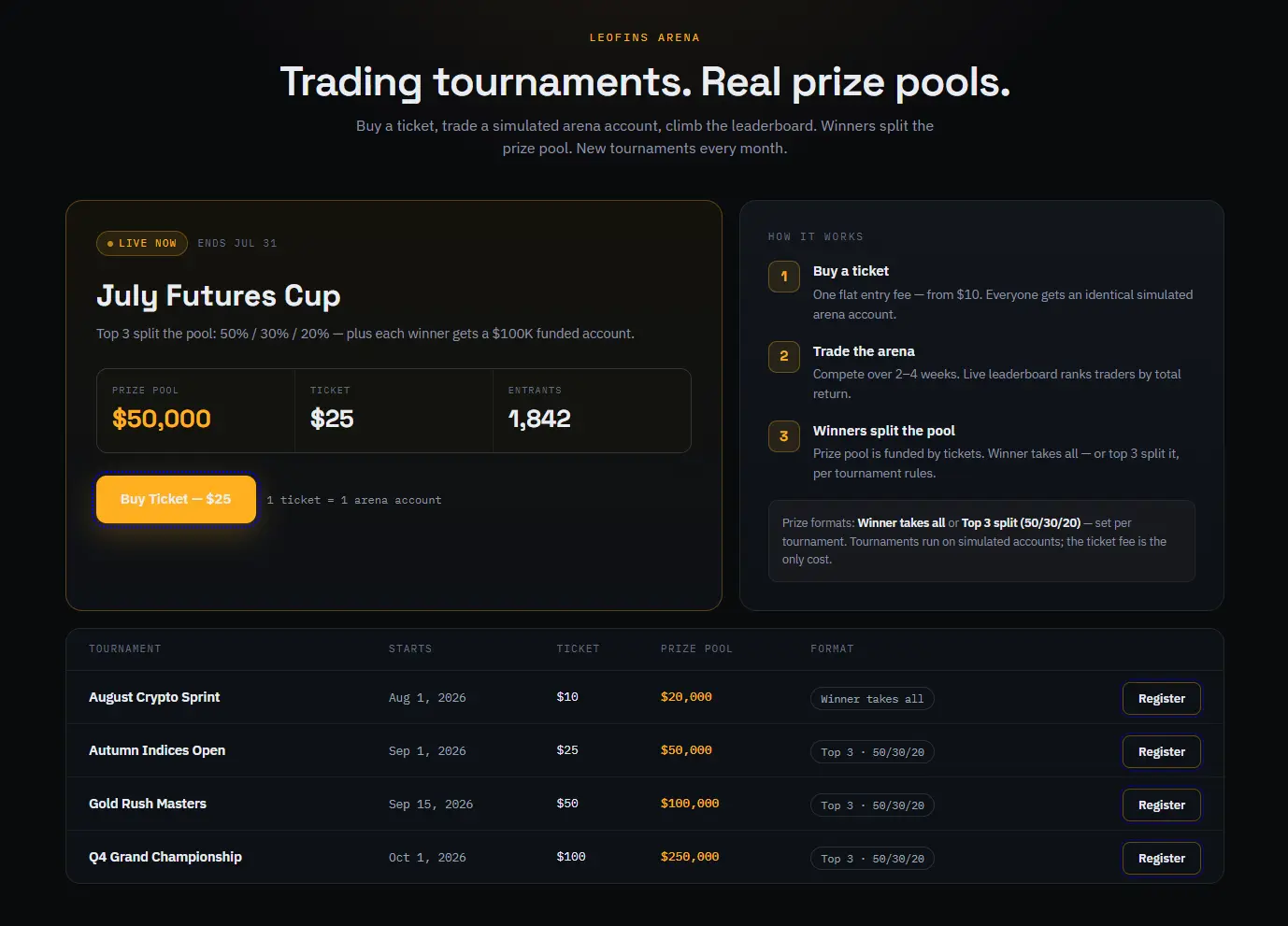 Leofins uses a one-time challenge-fee model across its Core 2-Step, Edge 1-Step, and Starter 3-Step programs. The published entry price starts at $59 for the Starter program, although the actual price depends on the selected account and program. The firm also states that qualifying challenge fees are refunded in full at a defined reward milestone: the first reward payout for Core and Starter, and the second for Edge.
The absence of a monthly subscription can be useful for traders who want to avoid ongoing billing while they wait for suitable setups or work through an evaluation. Leofins also lists platform and market-data fees at $0, and states that it charges no withdrawal fee. Applicable trading commissions and currency conversion costs should still be considered.
Its three evaluation formats have different target and loss-limit structures, so the lowest entry price is not necessarily the best choice for every trader. The Starter route spreads its profit target across three phases, Core uses two phases, and Edge has a single evaluation phase with a tighter loss envelope. Traders should compare these requirements with their strategy and risk tolerance.
The firm’s evaluation and funded accounts are simulated. A successful evaluation does not mean the advertised account size is deposited as real capital; eligibility for performance-based rewards is governed by the firm’s agreement and conditions.
For current fees and program terms, visit https://www.leofins.com/. Compare the amount you could lose on an unsuccessful attempt with the amount you would pay under a recurring plan over the same period.
How to Choose the Right Pricing Model for Your Situation
The following framework can help narrow the choice without assuming that one payment structure is best for everyone.
Choose a one-time fee if:
- You want to know the initial challenge cost before starting.
- Your strategy sometimes requires waiting for suitable market conditions.
- You can afford to lose the fee if the evaluation fails.
- You have checked reset, refund, and inactivity rules.
Consider a subscription if:
- A smaller upfront payment is important.
- You have a realistic plan for completing the evaluation within a limited number of billing cycles.
- You understand the renewal and cancellation terms.
- You have included activation fees and other charges in your calculation.
In either case, set a maximum budget for all attempts combined. If the first evaluation fails, review what happened before buying another. Repeatedly paying for challenges without improving risk management can turn either pricing model into an expensive habit.
Frequently Asked Questions
What is a prop firm?
A proprietary trading firm offers a program that evaluates traders against defined performance and risk rules. Many retail prop firms use simulated trading accounts and may provide eligible traders with performance-based rewards under a contractual agreement. The exact arrangement depends on the firm and program.
Which prop firm should a beginner start with?
There is no universally best firm. FTMO and The5ers offer one-time-fee evaluation options, Topstep provides subscription-based futures evaluation paths, FundedNext has several challenge formats, and Leofins offers one-time challenge fees with published refund milestones. Beginners should compare the specific program rules, total costs, and markets before choosing.
Is the money in a prop firm account real?
Many retail prop firm evaluation and funded accounts operate in simulated environments. The advertised account balance is not necessarily real capital deposited for the trader to control. Eligible rewards are generally paid under the firm’s terms, so check whether the particular program uses simulated or live trading.
Is a one-time prop firm fee always cheaper?
No. It can be cheaper if the evaluation takes several months, but repeated failed attempts may require repeated payments. A subscription may cost less if you pass quickly. Compare total costs over realistic timelines, including resets, activation fees, and any conditional refund.
Do prop firms refund challenge fees?
Some do, but refund rules vary. A refund may be linked to a first or later reward payout and may require compliance with specific conditions. Do not treat a possible refund as guaranteed money when calculating your upfront budget.
What happens if I fail a subscription-based challenge?
The consequences depend on the firm’s terms. You may need to start a new evaluation, pay for a reset, or stop the subscription to avoid further renewals. Check whether billing continues after a breach and whether cancellation takes effect immediately or at the end of a billing period.
Should I choose the cheapest challenge?
Not on price alone. A cheap challenge can be a poor fit if its drawdown limits, targets, or trading restrictions do not match your strategy. Compare the entry fee, likely total cost, rules, and payout conditions together.
Compare the Full Cost, Not Just the Entry Price
One-time fees and subscriptions solve different budgeting problems. The first provides a more predictable initial charge, while the second spreads payments over time but can become more expensive if an evaluation takes longer than expected.
Before making a decision, estimate your likely completion period, include the cost of failed attempts, and check whether any refund depends on reaching a later payout milestone. For subscription plans, calculate the amount due over several billing cycles and include activation charges where applicable.
The most suitable program is one you can afford to attempt without financial pressure and whose rules align with a tested strategy. No billing model guarantees that you will pass an evaluation or receive rewards, so choose based on transparent terms and realistic costs rather than the smallest advertised payment.
Prices and conditions are current as of October 2026.
Risk disclaimer: Proprietary trading evaluations involve financial risk. Challenge fees may be lost if an evaluation is unsuccessful or program rules are breached. Simulated trading and funded-program results do not guarantee future performance or income. Review the current terms carefully and never spend money you cannot afford to lose.
Інформація про автора